Category Archives: Uncategorized

What data-driven tactics are OK? A quick note.

An uproar about data modeling was in full swing the last few days. The NYT reported that Target uses data to, well, target customers. It got one wrong (spilling the beans about a daughter’s pregnancy to her father!) by getting it right (quickly gathering, analyzing and distributing marketing based on data points that knew more about the daughter than the dad). The data screening and data modeling trends have long taken hold in our industry. Now we are starting to see even more potentially questionable applications of data taken from the corporate world, raising some base questions: What about privacy? What about effectiveness? What about competitive advantage? What about creeping people out?

This raises the question: how far can and should data analysis go in fundraising? As a card-carrying member of APRA, I value research, analytics and prospect management. Data are the fuel for fundraising. As a father, or as a recipient of seemingly countless fundraising calls from poorly trained solicitors via robo-dialing, or as a donor, I wonder everyday where fundraisers should draw the line.

This topic–what data is “available” and how can/should we use it to raise money–is increasingly salient because data points are increasingly available. How should you sort through the details? Here is my three-point quick assessment approach:

  1. My starting point is typically not just can you raise money with a data-driven tactic but will the tactic build relationships?
  2. In the long run, gimmicks and disingenuous strategies deliver fewer results than donor-centric and mission-critical approaches. Which is it?
  3. But, it may not be long before unheard of tactics become commonplace approaches. Do benefits outweigh risks?

So, the short answer to this profound question is that focusing on relationships first should provide the answer for your organization’s approach to what data and when. I’m planning a more thorough look at the topic later this year (HIPAA, FERPA, national do not call lists, consumer data applications, and more). In the meantime, I welcome your cases, conundrums, and ideas.
Improve Perception to Improve Partnership

Fundraising operations is a tough business. The many moving parts, the level of detail, the (mis)understanding across different departments and donors…these all make it a difficult area to effectively manage.

Perception is particularly challenging to handle. Sometimes, a single anecdote shapes our colleagues’ entire view of operations. One bad gift, one bad report, or one bad training experience can spoil the lot. But, you can avoid some of the pitfalls and improve perceptions. Have a look at this video (it’s a little long but worth it) to get some ideas on the common culprits and best solutions.

[youtube http://www.youtube.com/watch?v=HVtBwszW2N0&w=560&h=315]

What issues have most shaped your perceptions?

Synchronized Fundraising: 10 Tipping Points between Operations and Stewardship

The Association of Donor Relations Professionals (ADRP) is a terrific group of dedicated professionals helping our industry focus on the essential element of great fundraising–stewardship. I had a chance to conduct a webinar for a few hundred ADRP members on the topic of balancing donor relations with operations. This is a vitally important issue. The stronger the integration between the two efforts, the better stewardship your donors will receive.

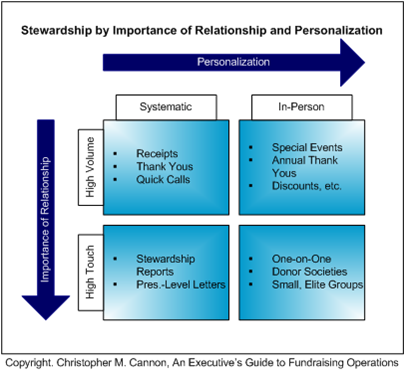
Stewardship moves from Systemic to Personal, High-Volume to High-Touch

This depiction illustrates the overlap. High-volume, high-tech donor relations is heavily reliant on operations. That is, receipts and acknowledgments generated from the database, accurate gift and recognition recording, and many other areas of great stewardship require great operational effectiveness.

So, what are the top 10 tipping points for, or prohibiting, integration of the two? These ten areas, when coordinated well, bode well for synchronized fundraising:

  1. Technology: ultimately these are means to an end, but using these tools well will improve the partnership.
  2. Online Engagement: some organizations would disagree, but, like technology, this is more of a channel than a strategy. It can be a valuable channel, though, and is often a little too technical for the stewardship team to manage alone.
  3. Prospect Development: operations often plays a bigger role on the front-end, leading to a two-stage process, but coordination is critical.
  4. Internal Reporting: operations holds the key to great reports. The more accurate, complete, and timely, the better donor relations can leverage information to build relationships with donors at the time of and between gifts.
  5. Data: accurate data are the basis for good reports, good receipts, and generally convincing your donors that you are an organization with its act together and worth supporting.
  6. Receipts and Acknowledgments: these are vitally important because they are often the first step in a chain of stewardship activities. Quick and accurate completion is often the responsibility of both teams.
  7. Impact Reports: reporting back to donors requires many sources. Operations and donor relations should work together here to ensure every donor gets the information they deserve.
  8. Recognition: the outward expression of gratitude for giving is mostly in the donor relations portfolio, but really great operations teams are vastly improving how that information is gathered, stored, and analyzed.
  9. Front-of-the-Line: I developed this idea to focus attention on top donors and prospects. The 80/20 rule is an axiom adopted by stewardship but operations folks sometimes just start at the top of the pile and work down. Instead, great partnerships should develop plans like the BIDMC team. Their SIRP (Stewardship Immediate Response Plan) ensures donors get the attention they deserve. And, the operations folks created solutions in their donor database to handle and streamline their process.
  10. Exception Management: Stewardship is essentially about exceptions. Operations is sometimes too, though it is more on negative exceptions (errors).
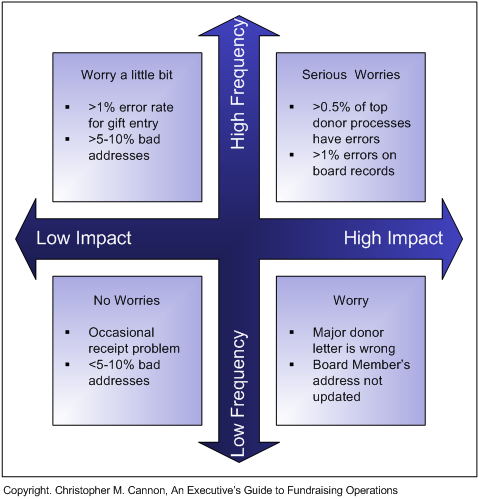
    Some exceptions and errors matter much more than others

    An integrated team will use points 1-9 to develop a thoughtful process that allows for disciplined handling of good and bad exceptions, so that your best donors and prospects always receive the lion’s share of your resources.

This last point is depicted here. The balance between operations and stewardship can be best summed up as a partnership to maximize donor experiences (partly by minimizing errors) in the upper right quadrant. Don’t sweat the small stuff in the bottom left quadrant.

Synchronizing operations and stewardship requires attention to data, technology, reporting, and business processes. To get these parts, pieces, programs, and processes spinning like a top, take a careful look at these ten areas of integration. The tighter the partnership between operations and stewardship, the better it is for you, your organization, and, most importantly, your donors.

Balancing when Busy

Fundraisers get busy. Indeed, being busy can be a sign of great things to come, so long as we’re busy with the right things. But, being busy can knock you out of balance. By carefully calibrating your perceptions, your performance, and your priorities, you can ensure that your daily “best practices” are really the practices that are best for your organization.

The forthcoming AFP’s Advancing Philanthropy includes a Management Trends article on this subject written by yours truly. It’s not exhaustive, but presents some helpful guidance for keeping your team productive and your work on target.

You can also click here to find this article on the AFP site. Have a look and let me know what you think. And, for more news and information on transforming philanthropy, visit my site at www.bwf.com or the fundraisingoperations.com site.

Spinning the Top

The central challenge in fundraising operations is managing data, technology, reporting, business processes, and people while balancing the countervailing forces of accuracy, speed, and volume. This new blog will focus on the difficulties that fundraisers experience and, more importantly, how to overcome these challenges, deliver results, and help our organizations raise more money and build more relationships.

I welcome feedback and input, stories and tales of success or caution.