Category Archives: advancement services

Leveraging your Systems in a Changing World

Competition in the fundraising software marketplace has yielded some big changes and some even bigger questions. Organizations are increasingly asking the “should I stay or should I go” question, no matter what system they’ve implemented. Questions of which vendor, which product, and with what impact and effects can be difficult to answer these days. Corporate mergers, shrinking client bases, growing product portfolios, and increasingly “flexible” applications complicate assessments.

Your fundraising software should help your organization raise money and build relationships. Period. As odd as it is coming from a fundraising operations guy, nonprofits can (potentially) raise as much money from Rolodexes as CRMs. But, better tools should support better results. So, what’s a smart fundraiser to do? Consider these five questions:

  1. Necessary vs. Nifty. If your team hasn’t shown the ability to leverage what’s already available and critical to supporting fundraising, a new and nifty tool won’t likely help.
  2. Expense vs. Cost. Change has costs, but your budget (within reason of typical fundraising results) should’t be the deciding factor. TCO (total cost of ownership) should include opportunity costs, which could show an inability to manage critical data and relationships that result in leaving money on the table (or not even knowing which table to visit!).
  3. Capacity vs. Complexity. New tools (or moving from old tools) can seem like a great option. The reality is often different from expectations, though. What may appear to be a penchant for expanded applications (capacity) is frequently stymied by the time and energy needed to adopt more complex tools.
  4. Perception vs. Performance. Perceptions about systems use (see Gartner.com’s hype cycle work) generally follow the “grass is greener” model. However, actual selection, conversion, and implementation of a new system may not generate the performance improvements desired.
  5. Culture vs. Change Management. Most tools are a reflection of the culture they support. Transparent teams like KPI’s and broad access to  systems because they foster openness. More risk averse teams may never be able to launch and leverage a robust CRM because they aren’t willing to share “so much data.”

These five contrasting issues are the starting point for your “stay or go” question. Before your team even starts to entertain the “where,” make sure you’ve established the “why” and that you’re asking the question for the right reasons. This will increase your likelihood to leverage systems, not just buy and install new, still-ineffectual tools.

These ideas stem in part from a series of client-based trips and discussions I’ve been involved with in recent weeks. We seem to start on the path of “tools” and move quickly to “behavior.”  There’s a potentially controversial tag line from the NRA that “Guns don’t kill people, people kill people.” The obvious point here is that tools are only as effective as those who use them. I prefer the message carried forward on Happy Gilmore with the Mr. Larson, aka Jaws from the Bond series wearing this great shirt–“Guns don’s kill people, I kill people.”

Of course, I’m no homicidal sociopath, I simply like the idea that it’s personal responsibility for the tool that yields the right results. So, to leverage your systems, look first in the mirror.
Quick Tax Tip

I’m no CPA, nor am I a lawyer. So, the tip here isn’t about taxes, per se. Instead, this quick note is to encourage your team to use tax time as  a stewardship touch. Advancement services, aka fundraising operations, gets caught at the wrong end of the 80/20 rule around tax time. We sometimes focus so much on volume (i.e., everybody gets a year-end statement) that we sacrifice quality. I’m not referring to accuracy but instead volume of effective touches. So, as April 15th comes along this year, commit your team to this top-focused, tax tip:

  1. Use tax time to ensure that every major prospect and donor gets a spring-time touch–in-person, call, or mail, in that order of preference.
  2. Create lists of “last fiscal year” donors who deserve a call to ensure that they have everything to support their giving.
  3. Engage portfolio managers to connect with every assigned individual along these lines. Non-donors could be contacted with a special script designed to engage them for the current year or reflect back on previous year’s giving.
  4. Make it a habit to go beyond any year-end giving statement for your best donors. Consider linking a tax message to a calendar year impact statement, complete with response devices for your donors.

Data suggest that donors claim that tax deductibility is  minor driver for gift decisions. Nonetheless, every American donor has potential gain from such tax issues, so your team should be prepared to engage every donor in the next few weeks to ensure that your organization’s gratitude–and ongoing worthiness and need for future support–are front-and-center.

“I’m calling on behalf of…”

Last night, 8:32 p.m. CT. A truncated transcript from a call (note: I’m sensitive to using a single anecdote to make decisions, but this was teachable moment):

(me): “Hello”

(some guy, about 10 second later): “Hello? Um, hello?”

(me): “What can I do for you?”

(some guy): “Is Mr. or Mrs. Cannon home?”

(me): “This is Chris Cannon?”

(some guy): “This is [name] calling for [top 10 national nonprofit]. I’m not calling to raise money. [really?] I’m calling to ask you to write10-15 letters…[script went on for another minute]”

(me): “Thanks. That’s not really how we like to participate in the organizations we suppo…”

(some guy): Click.

Seriously? I answered the phone, listened to some guy, and was interested enough in the organization to start to tell him how I might become engaged and that guy hung up. The reminder here is that we entrust dozens, maybe hundreds of people to our philanthropic brand each day. Are you doing all you can to train, engage, and otherwise prepare these folks to be good stewards of your good will? Are callers on quotas that diminish real discussions? If you’re not addressing these issues, your fundraising may suffer along with your brand.

The phone call didn’t provide the only lesson, though. After hang-ups, etc., I frequently call the organization back. I care a lot about nonprofits, and I’d bet management would like to know when their good reputation is being sullied.

So, in calling this organization back, an odd and maybe very dubious thing happened. The 800 line provided an opt-out (“press 2 if you do not want to receive calls like this”). I pressed “2”. Then, I had an option to add my number to the organization’s opt-out list. Terrific, I thought. I didn’t want more wasted calls like the one I had just experienced. Next, though, a very curious thing happened. I entered my phone number but the computer program didn’t register it correctly. I entered my area code but the computer-generated response indicated a different number. My wife watched me enter the correct number, only to hear the wrong number repeated back. I hung up and called back with similar results. I tried a third time and the computer program finally “figured” it out. Computer programs can fail, of course, but it sure felt like a purposeful, nearly endless loop to get off the list.

So, the second lesson of such a call is that, even if it’s an error or an oversight, you can lose potential donors forever by appearing to be too automated, too computer-driven, and too focused on your agenda rather than your potential donors. Fundraising is my vocation and I encourage groups to push their boundaries. For example, I frequently tell healthcare nonprofits that it’s patently irresponsible not to engage patients as potential donors. I do so because it can raise dollars and I truly believe in the power of philanthropy in the healing process (see a great application from Children’s Minnesota). This advice isn’t about limiting efforts but your strategy should mirror your constituency and stay away from gimmicks.

I’d love to hear your stories about these sorts of experiences. Together, we can help to keep our reputations strong and our (potential) donors happy.

3 Solutions to Prospecting Problems

After 1,000’s of discussions with gift officers and prospect development professionals around the world, I’ve come to a simple conclusion: we could all be doing more. More research. More discovery. More proposals. More prospect management meetings. More data entry and tracking. More, well, fundraising. What I have mostly learned, though, is that doing more through better partnership is attainable using three easy-to-remember tactics.

The Obstacles:

Discussions with prospect development professionals in research, prospect management and analytics typically include sentiments like:

  • “Sometimes I hear back from the fundraiser, but I usually don’t.”
  • “I don’t even know if they read the profile.”
  • “The meetings we hold are so frequently canceled or ignored, I don’t know why we bother.”

From frontline fundraisers, I hear all too often:

  • “I’m increasingly just using Google…”
  • “Prospect management meetings and other parts of the process really have nothing to do with how I operate.”
  • “It’s tough to be subjected to a barrage of questions from folks who’ve never asked for a big gift.”
The reality is that both sides are partly right and partly wrong. To move forward to deliver really extraordinary results, your team needs to overcome these obstacles. Here are the three ingredients to the solution:

The Solution

There are three simple tactics that address these issues:

  1. Respect: All sides bring value. Respecting each other’s strengths does not diminish our own. Instead, all parties need to celebrate what they do best and bring to the table. Every great organization succeeds through an effective division of labor, so make sure all divisions are respected in the process.
  2. Discipline: Neat and nifty tools and options are a distraction. So, new predictive models, meeting approaches, or discovery tactics need to be rooted in a disciplined focus on what’s best for donors and our organizations. This means no Blackberrys and iPhones in meetings and it means no “information for information’s sake” 20 page profiles.
  3. Planning: Fundraising is challenging because its not transactional. We cannot force (or even persuade) donors to give big gifts, so this means we must all be strategic planners. You must use every bit of intelligence, every database field, and every chance encounter with great prospects to build a team-wide plan to engage the best prospects. Then remembering the respect-discipline tactics, rigorously execute plans.

Team-based solutions for prospect development are best, but they are elusive. Many 1,000’s of conversations on the topic have convinced me, though, that the issue isn’t the database or the reporting scheme. It’s not the codes or other system details. The root challenge–and, consequently, the source of the solution–is more elementally embedded in how we respect each other, focus our energy, and plan for the future.

How much is that donation in your window? Calculate the Costs.

I get this question a lot: how much should it cost to process a gift? It’s a valid question most easily handled with: “It depends.”  Well, I’m tired of that answer so I’ve devised a calculation. My math is not as important as your organization’s math, but we should all be more focused on how to deliver more resources to forward our missions (i.e., streamline costs and/or increase revenues).

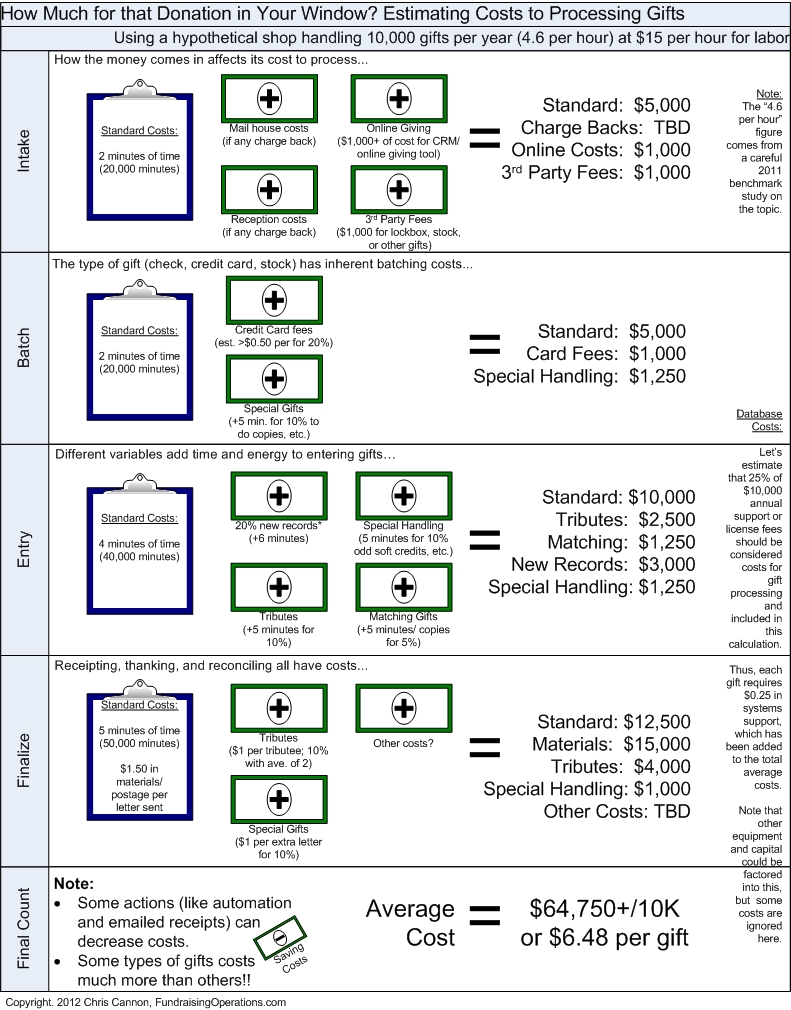
What are the costs of processing a gift or pledge? The components vary, by gift type, organization type, and others. The main cost is staff time, but we should also include a portion of the database costs, any services or service fees, and the materials/resources involved.

With costs estimated, how do these costs accumulate? Gift processing has four stages–intake, batching, entry, and finalization–so I’ve explored each to give a sense of costs per stage:

  • Intake: how the gift comes in affects costs.
  • Batching: the type of gift and associated information should be factored in.
  • Entry: some gifts take a lot longer to enter than others.
  • Finalization: receipts, thank yous, and reconciliation all take time and money.

Of course, every organization will differ in the actual calculation. That’s part of what makes this such a hard number to determine. Have a look at this infographic that calculates the cost to process each gift:

Processing gifts costs variable amounts
Your team's numbers will differ, but these components add up

The bottom line is that all gifts cost time, energy, and resources to process. Is your cost $6.50 per gift? Is it much more? Less? If your team is too efficient, you may be missing stewardship or quality control opportunities. Below some level, a gift costs an organization money. That number is probably closer to $20 for some gifts (tributes) than anyone would like to admit, especially if your team processes thousands of $20 gifts. The nature of philanthropy makes it nearly impossible (and certainly un-palatable) to reject small gifts, but messaging around the impact of giving could switch from the overly naive “every dollar counts” notion to something more sophisticated. So, be sure your efforts are pointing donors in the right  direction.

Don’t take my word for it. Do the math. Then, with your organization’s answer(s), try to shape donor behaviors through smarter direct response strategies supported by streamlining your operations so that you deliver as much money as possible to support your mission.

And, please share your calculations and ideas in the comments.

What data-driven tactics are OK? A quick note.

An uproar about data modeling was in full swing the last few days. The NYT reported that Target uses data to, well, target customers. It got one wrong (spilling the beans about a daughter’s pregnancy to her father!) by getting it right (quickly gathering, analyzing and distributing marketing based on data points that knew more about the daughter than the dad). The data screening and data modeling trends have long taken hold in our industry. Now we are starting to see even more potentially questionable applications of data taken from the corporate world, raising some base questions: What about privacy? What about effectiveness? What about competitive advantage? What about creeping people out?

This raises the question: how far can and should data analysis go in fundraising? As a card-carrying member of APRA, I value research, analytics and prospect management. Data are the fuel for fundraising. As a father, or as a recipient of seemingly countless fundraising calls from poorly trained solicitors via robo-dialing, or as a donor, I wonder everyday where fundraisers should draw the line.

This topic–what data is “available” and how can/should we use it to raise money–is increasingly salient because data points are increasingly available. How should you sort through the details? Here is my three-point quick assessment approach:

  1. My starting point is typically not just can you raise money with a data-driven tactic but will the tactic build relationships?
  2. In the long run, gimmicks and disingenuous strategies deliver fewer results than donor-centric and mission-critical approaches. Which is it?
  3. But, it may not be long before unheard of tactics become commonplace approaches. Do benefits outweigh risks?

So, the short answer to this profound question is that focusing on relationships first should provide the answer for your organization’s approach to what data and when. I’m planning a more thorough look at the topic later this year (HIPAA, FERPA, national do not call lists, consumer data applications, and more). In the meantime, I welcome your cases, conundrums, and ideas.

Improve Perception to Improve Partnership

Fundraising operations is a tough business. The many moving parts, the level of detail, the (mis)understanding across different departments and donors…these all make it a difficult area to effectively manage.

Perception is particularly challenging to handle. Sometimes, a single anecdote shapes our colleagues’ entire view of operations. One bad gift, one bad report, or one bad training experience can spoil the lot. But, you can avoid some of the pitfalls and improve perceptions. Have a look at this video (it’s a little long but worth it) to get some ideas on the common culprits and best solutions.

[youtube http://www.youtube.com/watch?v=HVtBwszW2N0&w=560&h=315]

What issues have most shaped your perceptions?

Synchronized Fundraising: 10 Tipping Points between Operations and Stewardship

The Association of Donor Relations Professionals (ADRP) is a terrific group of dedicated professionals helping our industry focus on the essential element of great fundraising–stewardship. I had a chance to conduct a webinar for a few hundred ADRP members on the topic of balancing donor relations with operations. This is a vitally important issue. The stronger the integration between the two efforts, the better stewardship your donors will receive.

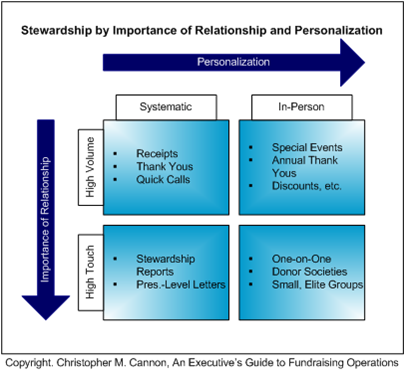
Stewardship moves from Systemic to Personal, High-Volume to High-Touch

This depiction illustrates the overlap. High-volume, high-tech donor relations is heavily reliant on operations. That is, receipts and acknowledgments generated from the database, accurate gift and recognition recording, and many other areas of great stewardship require great operational effectiveness.

So, what are the top 10 tipping points for, or prohibiting, integration of the two? These ten areas, when coordinated well, bode well for synchronized fundraising:

  1. Technology: ultimately these are means to an end, but using these tools well will improve the partnership.
  2. Online Engagement: some organizations would disagree, but, like technology, this is more of a channel than a strategy. It can be a valuable channel, though, and is often a little too technical for the stewardship team to manage alone.
  3. Prospect Development: operations often plays a bigger role on the front-end, leading to a two-stage process, but coordination is critical.
  4. Internal Reporting: operations holds the key to great reports. The more accurate, complete, and timely, the better donor relations can leverage information to build relationships with donors at the time of and between gifts.
  5. Data: accurate data are the basis for good reports, good receipts, and generally convincing your donors that you are an organization with its act together and worth supporting.
  6. Receipts and Acknowledgments: these are vitally important because they are often the first step in a chain of stewardship activities. Quick and accurate completion is often the responsibility of both teams.
  7. Impact Reports: reporting back to donors requires many sources. Operations and donor relations should work together here to ensure every donor gets the information they deserve.
  8. Recognition: the outward expression of gratitude for giving is mostly in the donor relations portfolio, but really great operations teams are vastly improving how that information is gathered, stored, and analyzed.
  9. Front-of-the-Line: I developed this idea to focus attention on top donors and prospects. The 80/20 rule is an axiom adopted by stewardship but operations folks sometimes just start at the top of the pile and work down. Instead, great partnerships should develop plans like the BIDMC team. Their SIRP (Stewardship Immediate Response Plan) ensures donors get the attention they deserve. And, the operations folks created solutions in their donor database to handle and streamline their process.
  10. Exception Management: Stewardship is essentially about exceptions. Operations is sometimes too, though it is more on negative exceptions (errors).
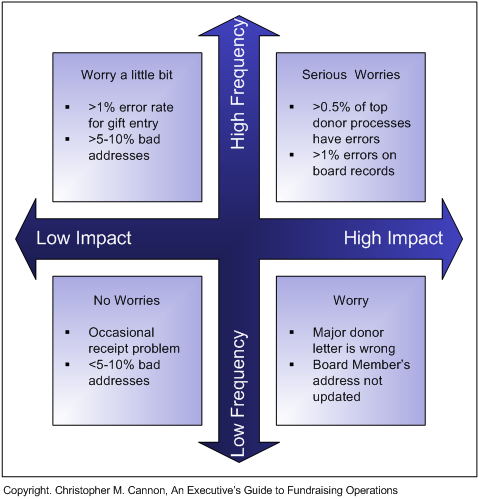
    Some exceptions and errors matter much more than others

    An integrated team will use points 1-9 to develop a thoughtful process that allows for disciplined handling of good and bad exceptions, so that your best donors and prospects always receive the lion’s share of your resources.

This last point is depicted here. The balance between operations and stewardship can be best summed up as a partnership to maximize donor experiences (partly by minimizing errors) in the upper right quadrant. Don’t sweat the small stuff in the bottom left quadrant.

Synchronizing operations and stewardship requires attention to data, technology, reporting, and business processes. To get these parts, pieces, programs, and processes spinning like a top, take a careful look at these ten areas of integration. The tighter the partnership between operations and stewardship, the better it is for you, your organization, and, most importantly, your donors.

Ends vs. Means: A Balanced View of Fundraising Technology

It seems that 2012 will be a year for change in fundraising operations. The proverbial dust is starting to settle on one of the two biggest fundraising operations stories in months. In January, Datatel and SungardHE finalized their merger (click here for details). January also held the other big story about the purchase of Convio by Blackbaud (click here for details).

The Twitterverse has been abuzz. ListServs, blog posts, calls to account managers…the volume of attention to these issues has been significant. How much does it matter? In total, not much.

Wondering if your technology is well-used. Click here for a Test.

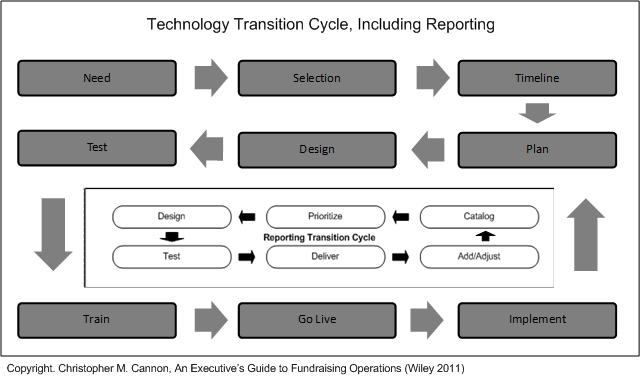
Fundraising is still a predominantly top-down, inside-out business (with some exceptions). Grass-roots, high-volume, high-tech fundraising is neat and (somewhat) new, but the essentials–asking engaged people of means for very large gifts–is where most campaigns are won. And, frankly, an organization’s database of choice affects these sorts of gifts less than we might think. For example, have a look at this technology transition cycle. What you will notice is that it’s a loop: you’re never quite finished because you should be constantly learning and adapting the use of your technology. Without long-range, comprehensive implementation plans to fully leverage our technology, we tend to have databases that house name, address, giving, and a few other details.

Now, this may sound odd coming from a guy who champions fundraising operations, published a book to inform fundraising ex Continue reading

Balancing when Busy

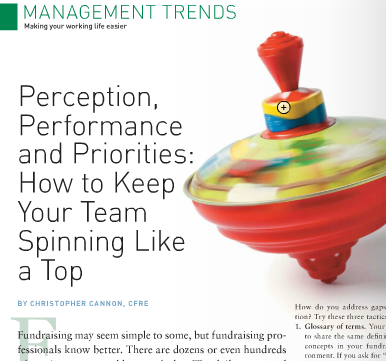
Fundraisers get busy. Indeed, being busy can be a sign of great things to come, so long as we’re busy with the right things. But, being busy can knock you out of balance. By carefully calibrating your perceptions, your performance, and your priorities, you can ensure that your daily “best practices” are really the practices that are best for your organization.

The forthcoming AFP’s Advancing Philanthropy includes a Management Trends article on this subject written by yours truly. It’s not exhaustive, but presents some helpful guidance for keeping your team productive and your work on target.

You can also click here to find this article on the AFP site. Have a look and let me know what you think. And, for more news and information on transforming philanthropy, visit my site at www.bwf.com or the fundraisingoperations.com site.